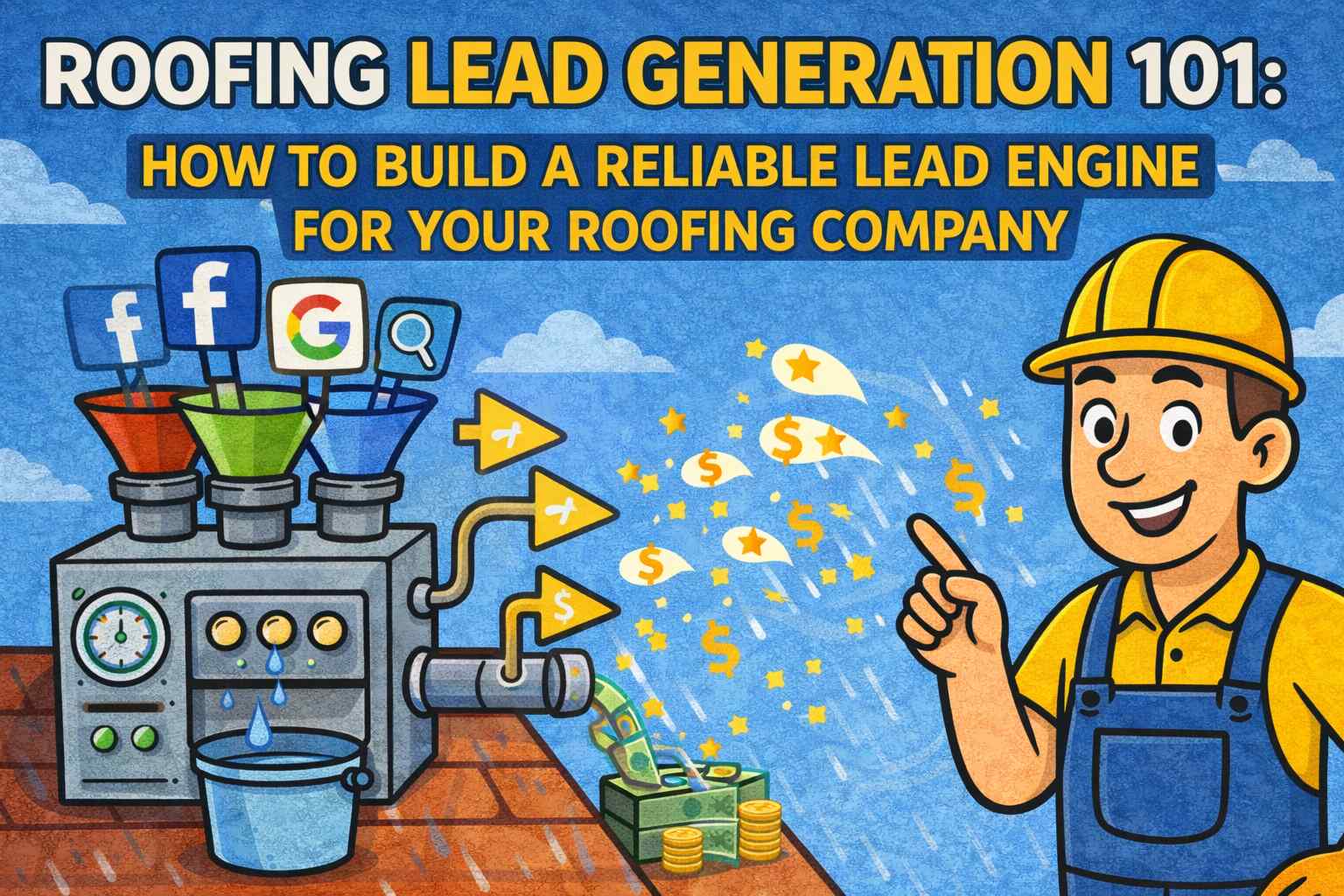
If your roofing business feels like a rollercoaster—one month you’re slammed with jobs, the next month the phone goes dead—you don’t have a marketing problem, you have a lead engine problem.
This guide walks you through how to build a reliable roofing lead generation system that doesn’t depend on luck, storms, or lead sellers like HomeAdvisor or Angi. By the end, you’ll know what pieces you need in place, which channels to focus on, and how to track whether your marketing is actually working.
What Is a Roofing Lead Engine (and Why You Need One)?
A roofing lead engine is a simple system that consistently turns strangers into booked appointments and signed contracts.
Instead of random “one-off” marketing tactics, a lead engine:
- Attracts the right homeowners or property managers
- Sends them to a clear landing page or offer
- Captures their info with forms or calls
- Pushes them into a follow-up process until they buy
When this system works, you can:
- Predict roughly how many leads you’ll get each month
- Estimate how many jobs and how much revenue that should turn into
- Scale up or down by adjusting your ad spend and outreach
That’s how roofing companies break out of the feast-or-famine cycle and start planning growth with confidence.
Step 1 – Get the Foundations Right (Offer, Niches, Numbers)
Before worrying about Google, ads, or SEO, you need clarity on three basics.
Know who you actually want as a customer
You’ll get better results if your lead engine is built around a specific type of customer, not “everyone with a roof.”
Examples:
- Residential homeowners in mid–high income neighborhoods
- Commercial property managers with flat roofs
- HOA and condo boards
- Industrial facilities with large flat roofs
Each group searches differently, responds to different offers, and has different sales cycles. Choosing your core segment first keeps your marketing focused.
Decide which roofing services you want more of
Common focus areas:
- Storm/insurance replacement
- Retail replacements (cash or financing)
- Commercial flat roof recover/re-roof
- Maintenance programs and small repairs
Your messaging should match the work you actually want more of—not just “free estimates.”
If you’re not sure what mix to focus on, that’s something we map out with contractors on our Services overview at:
https://roofingleads.help/services/
Know your numbers (so you can set real lead targets)
A simple example:
- Average residential roof job: $12,000
- Gross profit: 40% ($4,800)
- Close rate: 30% (you close 3 of 10 leads)
If each closed job is worth $4,800 of gross profit, then each qualified lead is worth about $1,440 in gross profit ($4,800 ÷ 3).
If you want an extra $48,000 in gross profit per month, you’ll likely need around:
- 10 extra jobs per month
- ~33–35 good leads per month
These numbers tell you how aggressively you can invest in roofing lead generation and when you might want a partner to help you scale (again, see: https://roofingleads.help/services/).
Step 2 – Turn Your Website into a Lead-Generating Hub
Most roofing sites are basically online business cards. A lead engine website is different: it’s built to turn traffic into calls, form fills, and booked appointments.
Must-have elements on your roofing website
- Clear headline
Who you serve and what you do: “Residential & Commercial Roofing in [Your City]” beats “Welcome to XYZ Roofing.” - Strong offer
Free inspection, second opinion on an insurance scope, emergency leak response, or maintenance plan—something specific. - Easy ways to contact you
Click-to-call buttons, short forms above the fold, and options to text or chat. - Trust elements
Reviews, before/after photos, certifications, warranties, and guarantees. - Local signals
Cities and neighborhoods served, local photos, and targeted pages similar to how you’d structure content under:
https://roofingleads.help/locations/
Every marketing channel you use—Google Ads, Local Services Ads, SEO, social media—should push traffic to a page built to convert, not a generic homepage.
For more ideas on how your site and funnel should fit into your overall marketing, keep an eye on the educational posts at:
https://roofingleads.help/blog/
Step 3 – Core Channels for Predictable Roofing Leads
A reliable lead engine doesn’t rely on just one channel. It’s a mix of “fast” and “slow” traffic sources that work together.
Google Business Profile and Local SEO
Your Google Business Profile (GBP) and Map Pack rankings are often the first thing homeowners see.
Key basics:
- Fully filled-out profile with your main services and service areas
- Real photos of your roofs, crews, and equipment
- A consistent system for asking happy customers for reviews
- Posts and updates during busy seasons (storm events, winter prep, etc.)
Local SEO on your website (service pages, city pages, and blog posts) helps you show up for searches like “roofing company near me” or “roof repair in [city].” Educational content—like the guides we publish on https://roofingleads.help/blog/—supports this and builds authority.
Google Ads and Local Services Ads (LSAs)
Paid search is the fastest “on-demand” roofing lead source when done correctly:
- Target high-intent keywords like “roof replacement [city]” or “commercial roofer [city]”
- Send traffic to focused landing pages (one service, one offer, one CTA)
- Use call tracking and form tracking so you know which campaigns bring real booked jobs
- Watch cost per lead and cost per booked job—not just clicks
In a proper lead engine, Google Ads and LSAs are controlled levers you can turn up or down, not random gambles.
Meta Ads (Facebook/Instagram) for Roofing Leads
These platforms shine at:
- Promoting specific offers (storm inspections, seasonal tune-ups, financing specials)
- Retargeting people who visited your site but didn’t call or book
- Staying visible in your core neighborhoods and markets
The key is sending clicks to a specific offer page and having follow-up in place, instead of dumping everyone on your homepage.
When we build systems for clients through the services listed at https://roofingleads.help/services/, we typically combine GBP, SEO, Google Ads/LSAs, and retargeting for a more stable lead flow.
Step 4 – Build a Simple Roofing Sales Funnel
A roofing lead engine doesn’t stop when someone fills out a form or calls your office. That’s the middle of the funnel.
A simple roofing funnel looks like this:
- Attention
Google search, LSAs, ads, social, referrals, email, direct mail—any way you get on someone’s radar. - Landing
The prospect lands on a page that matches what they were looking for: storm damage help, commercial flat roofs, or residential replacement. - Conversion
They call, submit a form, or request an inspection/estimate. - Scheduling
Your office or team gets them booked quickly. The faster the response, the higher the close rate. - Inspection and proposal
Your rep inspects the roof, documents issues, presents options, and clearly explains the value—not just the price. - Follow-up
Texts, calls, and emails for leads who don’t sign on the spot.
If you don’t have a follow-up system, you’re wasting 20–40% of the leads you’re already paying for. A good CRM and a simple process (status updates, reminders, automations) turn more of your opportunities into signed contracts.
Step 5 – Track, Improve, and Scale Your Lead Engine
You can’t fix what you don’t measure. At a minimum, track:
- Leads per month by channel
SEO, GBP, Google Ads, LSAs, Facebook/Instagram, referrals. - Cost per lead (CPL)
Especially for paid channels. - Appointment set rate
How many leads actually become booked inspections. - Close rate
How many inspections turn into signed jobs. - Cost per acquired customer (CAC)
Total marketing spend ÷ number of new customers. - Revenue and profit by channel
So you know which channels are worth scaling.
Even a basic spreadsheet or simple CRM reporting is enough to spot:
- Which campaigns and keywords are working
- Which service areas are most profitable (you can build more content/ads focused on those locations, similar to how you’d expand under https://roofingleads.help/locations/)
- Where leads are falling out of your funnel (no answer, no shows, slow follow-up, etc.)
Once you know your numbers and have a reliable process, scaling becomes straightforward: invest more into what works and cut what doesn’t.
When to Bring in a Roofing Lead Generation Partner
You can absolutely DIY parts of this system. But it often makes sense to bring in a specialist when:
- You’re already spending on ads but can’t clearly see ROI
- Your office is too busy to manage landing pages, tracking, and optimization
- You want to move from “random lead spikes” to a predictable growth plan
- You’re expanding into new cities or commercial work and need a scalable lead system
A good roofing lead gen partner should:
- Focus on roofing or at least home services
- Explain clearly how leads are generated and tracked
- Help you improve your sales process and follow-up, not just send raw “names and numbers”
- Be transparent about results, costs, and realistic expectations
If you want help designing a full roofing lead engine for your business, you can book a strategy call here:
https://roofingleads.help/contact-2/
On that call, we’ll look at your market, your current lead flow, and map out a plan to get you more consistent, higher-quality roofing leads.
Next Steps: Start Building Your Roofing Lead Engine This Week
You don’t need to rebuild everything overnight. Start with:
- Clarifying your ideal customer and your top-profit services
- Making your website and landing pages conversion-focused
- Optimizing your Google Business Profile and review system
- Adding one reliable paid channel (like Google Ads or LSAs)
- Implementing simple tracking for leads, appointments, and jobs
From there, you can layer on content, SEO, and more advanced campaigns. For deeper dives into specific channels and strategies, check the guides on:
https://roofingleads.help/blog/
And if you’d rather skip the trial-and-error and get a custom plan built for your market, request a roofing lead generation strategy call here:
https://roofingleads.help/contact-2/